
FCL and LCL are two ways to move containerised cargo. With full-container-load service, a container is allocated to the relevant shipment arrangement; with less-than-container-load service, cargo shares container capacity with other consignments. The right choice depends on more than whether your boxes can physically fill a container.
Compare the complete movement: accepted cargo characteristics, chargeable measurements, origin and destination services, handling, receiving timetable and total cost. This guide provides a practical comparison exercise for Indian exporters. It does not prescribe a universal volume threshold or promise that one service is always faster.
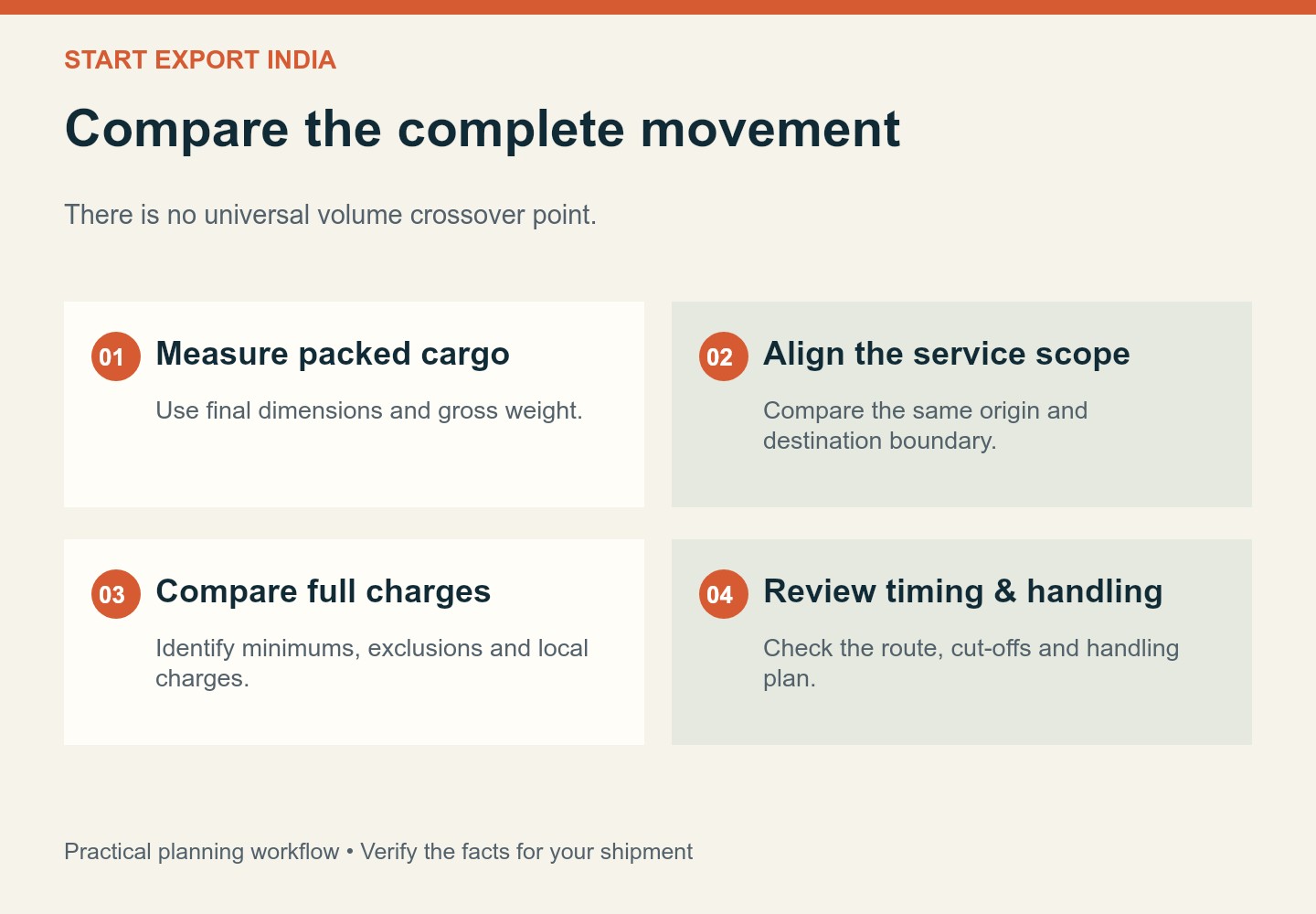
Begin with final packed measurements
Obtain the package count, external dimensions, gross weight, stacking limitations and any special handling requirements. A product's net weight or an unfinished packing estimate is not enough to obtain a reliable comparison. Ask the provider how it will determine chargeable quantity and what happens if the final measurements differ.
For rectangular packages, a simple geometric volume calculation is length × width × height, with all measurements converted to metres. That calculation gives physical cubic metres; it does not, by itself, determine every provider's chargeable basis. Minimums, density rules, rounding and service conditions need written confirmation.
Understand the service difference without oversimplifying it
Maersk's FCL and LCL overview explains the distinction between dedicated and shared container capacity. Shared cargo commonly involves consolidation activities; a dedicated container arrangement can still involve inland handling, transshipment and other operational stages.
Do not translate “FCL” into “direct vessel” or “no handling risk.” Ask about the actual route, receiving point, cut-offs, transport stages and final delivery. Likewise, do not assume that every LCL service will follow the same consolidation timetable. The provider's specific plan matters.
Compare a common service boundary
Write down the exact origin and destination boundary before requesting quotations. A port-to-port price and a pickup-to-warehouse price are different products. Separate seller-paid services from charges that the consignee will pay, and identify exclusions explicitly.
| Comparison row | LCL quote | FCL quote |
|---|---|---|
| Packed cargo accepted | Confirm quantity, weight and characteristics. | Confirm container type, loading feasibility and limits. |
| Origin services | Identify receiving, handling and consolidation scope. | Identify pickup, loading, terminal and documentation scope. |
| Main carriage | Confirm the chargeable basis and route. | Confirm the container-level rate and route. |
| Destination services | Confirm handling, deconsolidation and release charges. | Confirm terminal, release and delivery boundaries. |
| Timing | Ask for receiving, consolidation and estimated arrival milestones. | Ask for equipment, cut-offs and estimated arrival milestones. |
| Exceptions | Record storage, revisions and other contingent charges. | Record storage, equipment-related and other contingent charges. |
Use this as a quotation-request worksheet. It does not mean that every line is separately charged on every route.
Worked example: calculate the physical shipment volume
Assume a fictional order consists of 40 cartons. Each finished carton measures 0.60 m × 0.40 m × 0.40 m. The physical volume per carton is 0.096 cubic metres, so the total is 3.84 cubic metres. Suppose the measured gross weight is 600 kg.
Send both figures to each provider, together with the product description and stacking information. Ask for the service's chargeable basis rather than assuming that 3.84 cubic metres will be the final billing quantity. If the cartons require pallets, provide the final palletised dimensions and weight instead of quoting the bare-carton total.
A packing change can alter both the volume and the handling plan. Recalculate before confirming the booking. Keep the measurement record in the packing and document file so the commercial and logistics teams use the same version.
Worked example: compare total quotations
For teaching only, imagine an LCL seller-paid quotation of ₹32,000 for a defined scope and a comparable FCL quotation of ₹55,000. If those are the complete equivalent seller-paid scopes, the visible difference is ₹23,000. These invented figures are not market freight rates.
Now suppose the LCL destination charges remain unconfirmed while the FCL quote includes a clearly stated destination service. The initial comparison is incomplete. Obtain the missing amount or compare a narrower common boundary. Do not enter zero merely because the quote leaves a blank.
If a larger order changes the LCL chargeable quantity, request a fresh pair of quotations. There is no useful universal rule that one particular cubic-metre figure is always the crossover point. Route, cargo, service boundary, timing and current provider pricing can change the result.
Consider handling and product suitability
Ask how the cargo is received, stored, consolidated, separated and delivered. Fragility, moisture sensitivity, odour, contamination concerns, temperature needs and stacking restrictions can affect service acceptance and packaging. Obtain specialist advice for regulated or hazardous goods; do not rely on a generic comparison chart.
Review the export packaging checklist with the chosen provider. Packing designed only to survive one controlled loading operation may be unsuitable for a service involving additional handovers. Insurance and provider liability should also be reviewed separately from the freight rate.
Check the timetable and contingencies
Build a milestone list covering cargo readiness, pickup or warehouse receipt, documentation, relevant cut-offs, planned departure and estimated arrival. Ask what changes if cargo misses a cut-off or a service is revised. Record the next available option and the person authorised to approve additional costs.
Avoid promising a fixed delivery date from an unqualified transit-time estimate. Ask what the estimate includes and which stages sit outside it. Your buyer may care about receiving goods at its facility, while the provider's advertised time may concern a narrower transport leg.
Make the decision visible to the buyer and your team
Write a short decision note explaining the selected service, the compared alternatives, the cost boundary and remaining assumptions. Identify who approved the packaging, quotation and delivery expectations. This is especially useful if a later invoice or schedule differs from the original plan.
Review the completed shipment afterwards. Compare actual charges and milestones with the approved quotation and use the evidence in the next enquiry. A good decision process improves with real results rather than turning one shipment's experience into a permanent rule.
Frequently asked questions
Must a container be completely full to use FCL?
Not necessarily. Ask whether the dedicated-container cost and operational arrangement suit your cargo. Physical fullness is only one consideration.
Is LCL always cheaper for small shipments?
It can be attractive, but compare complete equivalent services, including relevant destination charges and minimums. Obtain actual quotations.
Is FCL always faster?
Do not assume it. Compare the proposed service, route and complete timetable. Dedicated capacity does not guarantee a direct sailing or a fixed arrival date.
Which measurements should I provide?
Provide final external packed dimensions, count, gross weight and special handling constraints. Ask how the provider calculates the chargeable basis.
Your next step
Prepare one shipment brief and send it to suitable providers. Use the freight-forwarder comparison guide to review the answers and your cost sheet to test the effect on the order price.