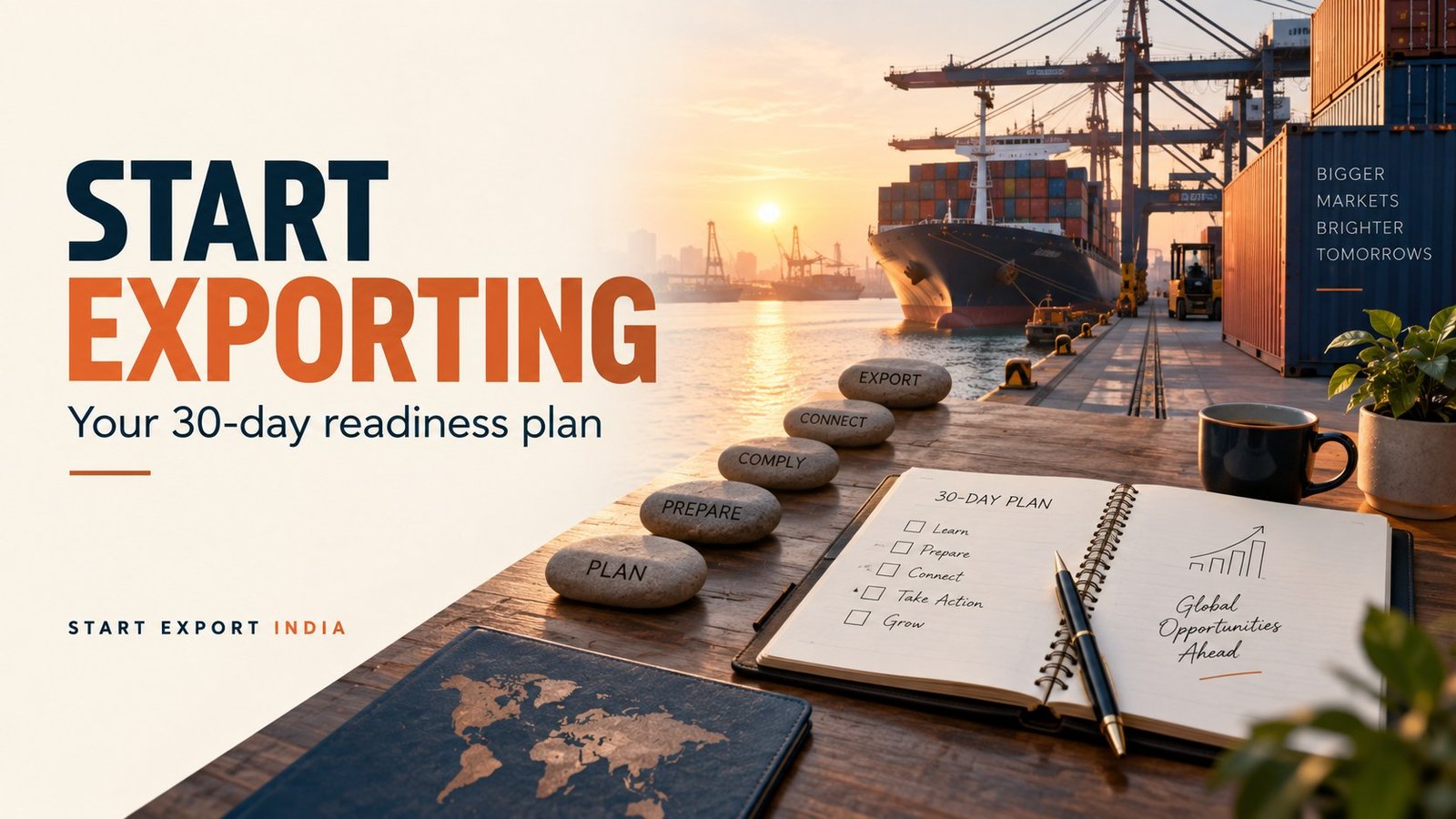
To start an export business in India, choose a product you can supply, research a target market, confirm the applicable setup and product requirements, calculate a workable price and test a defined buyer enquiry. A registration or a buyer list is only one part of that process.
This guide turns those decisions into a practical 30-day plan for a new manufacturer or merchant exporter. The schedule helps organise research; it does not promise approvals or an order within a month.
How to start exporting from India: the first five steps
- Define your product: specification, quantity, packing and a supplier you can verify.
- Research one destination: buyer type, specifications, competitors and unanswered entry questions.
- Check your setup: exporter identity, product policy, banking arrangements and applicable permissions.
- Cost a realistic order: compare trial and repeat quantities, payment timing and quotation scope.
- Qualify a buyer enquiry: check the counterparty and agree specifications before promising production or delivery.
Work through the details below. Keep a dated evidence file so you can distinguish what is confirmed from what still needs research.
1. Choose one product you can describe and supply consistently
Start with a narrow product definition rather than “agricultural products” or “handicrafts.” A buyer needs to understand material, grade, dimensions, packaging, application and available quantity. Two items with similar names can have very different compliance requirements and freight economics.
Write a one-page product brief. Include the supplier location, minimum order quantity, production lead time, packing method and what can be customised. Distinguish information you have verified from information you still need from the manufacturer. If you are a merchant exporter, establish who is responsible for inspection, replacement of defective stock and export packing.
Ask your supplier for evidence behind capacity claims. A statement that a factory “can supply anything” is less useful than a confirmed schedule for a defined specification. Do not advertise certifications, origin claims or manufacturing ownership that you cannot substantiate.
2. Compare two markets before approaching everyone
Pick two plausible countries and research the same questions for both: who buys the product, what alternatives they use, what entry requirements apply, how it travels and whether the likely selling price can support your costs. A large import market can still be a poor starting point if entry costs or channel expectations are beyond your resources.
Build a short comparison sheet with columns for evidence, source date and unanswered questions. Look at actual importer or distributor websites to understand pack sizes and positioning. Treat marketplace listings as clues rather than proof of sales volume. A displayed retail price is not the price an importer can pay an exporter.
Your first decision may be to focus on a smaller market with accessible buyers and simpler logistics. It may also be to postpone exporting a particular product. Discovering an obstacle before buying stock is a useful result.
3. Build a product-specific compliance checklist
For an Indian business, begin checking the current requirements through DGFT, your authorised dealer bank and your customs professional. Confirm the role of the Importer Exporter Code, the product’s classification and export policy, and any permissions that apply to your situation. Do not use an old social-media checklist as the final authority.
Requirements can differ by product, destination and transaction. Food, plant material, chemicals, textiles and engineering products should not be treated as one identical process. Ask the buyer to identify destination requirements, then verify important points with the relevant authority or a qualified specialist. Buyer instructions alone are not a substitute for checking the law.
Create a register with four fields: requirement, responsible person, evidence and status. Use “not yet confirmed” where appropriate. This is more honest and more useful than putting a tick beside every item because a generic online list mentioned it.
India export setup: what to check and where
| Check | Practical next action |
|---|---|
| Exporter identity and IEC | Goods exporters generally need an IEC unless exempt. Check the DGFT IEC guidance and verify your business details. |
| Product classification and export policy | Confirm the product code, current policy and conditions through DGFT with your customs professional. |
| Bank and customs arrangements | Discuss your export account and AD-code arrangements with your bank and broker. ICEGATE publishes bank-registration guidance. |
| Tax and product-specific checks | Ask the appropriate adviser or authority which tax treatment, registrations, permissions and destination requirements apply to your actual goods and transaction. |
Keep business setup separate from order paperwork. Use our documents required for export from India checklist when preparing an individual shipment.
4. Calculate a price before promising a discount
Collect supplier costs, export packing, inland transport, documentation, handling, freight where included, insurance where applicable, banking charges and a reasonable contingency. Decide which costs belong to your proposed delivery arrangement. Record the source and validity of every third-party quotation.
Then calculate the selling price that supports your target gross margin. Margin and markup are different: if a defined cost base is ₹100 and the selling price is ₹125, the markup on cost is 25%, while the gross margin on selling price is 20%. A spreadsheet should make this distinction explicit.
Run a smaller-order scenario. Some expenses apply to the shipment rather than each unit, so an order for 200 units may need a higher unit price than an order for 2,000. Never reuse a large-order price for a small trial order without recalculating.
5. Decide how a first order would actually work
Map the sequence from enquiry to delivery: qualification, specification confirmation, sample if needed, quotation, purchase order review, payment arrangements, production, inspection, dispatch and documents. Put an owner against every step, even if you personally handle several steps.
Discuss payment options with your bank before accepting unfamiliar terms. Consider both nonpayment risk and the cash you need to fund production. A profitable order on paper can still create a cash shortage if the supplier must be paid well before the buyer pays you.
Prepare the buyer, supplier, document and payment steps together. Use our pro forma invoice checklist to review an offer before it becomes the basis of an order.
What costs should a new exporter budget for?
Build three budgets rather than relying on one advertised startup figure:
- Preparation: research, samples, supplier checks and any applicable professional or registration costs.
- Order execution: goods, packing, inspections, transport, documentation, bank charges and the costs included in your offer.
- Cash timing: what you must pay before the buyer pays, plus a clearly stated contingency.
Record each amount as a confirmed quotation or an estimate. Review a worked export cost sheet, or use the editable export costing calculator to compare your own assumptions.
A practical 30-day schedule
| Period | Work to complete | Evidence to keep |
|---|---|---|
| Days 1–7 | Define one product, compare suppliers and write the brief. | Specification, supplier answers and sample plan. |
| Days 8–14 | Compare two markets and investigate entry requirements. | Market notes, official sources and unresolved questions. |
| Days 15–21 | Collect logistics estimates and prepare three costing scenarios. | Cost sheet, quotation validity and cash requirement. |
| Days 22–30 | Prepare buyer messages and an order workflow; make a small, relevant outreach list. | Buyer research, tailored messages and follow-up record. |
These are planning windows, not regulatory processing times. If a compliance question remains unresolved, carry it forward as a blocker rather than rushing to meet the calendar.
Example: a merchant exporter considering cotton kitchen towels
Imagine a new exporter with access to a towel supplier. Instead of sending a broad catalogue, the exporter defines one towel size, fabric specification and carton configuration. Two markets are compared using buyer profiles, labelling questions and freight estimates. The first version of the cost sheet shows that a small trial shipment has high transport cost per unit.
The sensible response is to explore a different order quantity or packing configuration and ask buyers what trial size they normally evaluate. It is not to hide freight or promise an unsupported landed price. This example is hypothetical, and its purpose is to illustrate the decision process rather than identify a profitable product.
A practical first-order test for a corn-products exporter
The following scenario is illustrative. A new merchant exporter has a supplier for corn grits and a buyer willing to evaluate a sample. This is not yet an export order. Before treating it as revenue, assemble a small evidence pack that another person could review.
- Define the goods: agree the precise product, intended application and dated specification. Confirm who can verify the supplier’s batch and packing information.
- Define sample acceptance: record the sample reference, evaluator, method and response required. “Sample received” and “sample accepted for the proposed process” are different milestones.
- Test one shipment: for an illustrative 23-tonne enquiry in 50 kg net bags, plan for 460 bags, then confirm load feasibility and the final packing arrangement with the provider.
- Build cash timing: list when samples, goods, packing and logistics must be paid, and when buyer funds are expected under the proposed terms. Price a feasible order, not an order your cash cannot support.
- Resolve requirements: assign the product- and destination-specific checks to the appropriate advisers and authorities. Record unresolved items as blockers.
A useful day-30 output
End the first month with a dated product brief, a buyer-verification file, a sample record, an order-cost scenario and an open-issues register. For each open issue, identify the owner, evidence needed and next review date. A collection of registrations or a long buyer list cannot substitute for these decisions.
If the buyer changes from 50 kg to 25 kg bags, reopen packing cost, bag count, labelling and freight assumptions. For the same 23 tonnes, the planning count becomes 920 bags. Do not carry over the earlier price simply because the total net weight is unchanged.
Decision: proceed to the next agreed stage only when the evidence for that stage is complete. If a supplier cannot meet the accepted specification, revise the opportunity before collecting money or making a delivery promise.
What to measure before calling yourself ready
- Can you explain the exact product and provide consistent specifications?
- Do you know which requirements are confirmed and which remain open?
- Can you explain your quotation’s inclusions and exclusions?
- Have you checked supplier capacity and the cash needed for a trial order?
- Can you produce a coherent document trail from enquiry to dispatch?
- Is there a named person responsible for addressing a buyer complaint?
Use these questions as readiness gates. A buyer contact list is not a substitute for the ability to fulfil an order. Build a simple weekly review: what changed, what evidence was collected and what decision comes next.
Frequently asked questions
Do I need an IEC to export goods from India?
DGFT’s guidance generally requires an IEC for goods exports unless an exemption applies. Check the current rules for your business and product. The treatment of services differs, so do not apply a goods checklist to every service export.
Can I start as a merchant exporter?
You can explore sourcing from a manufacturer rather than making the product yourself, but you still need to establish your business’s responsibilities, applicable requirements and reliable supply arrangements. Clarify roles before quoting or taking an order.
How much money do I need?
There is no useful universal figure. Prepare a cash plan for your chosen product and order size, including samples, verification, logistics and the timing of receipts and payments. Keep personal and business budgets clear.
Will this plan guarantee my first buyer?
No. It helps you prepare and test assumptions. Demand, competition, compliance, pricing and buyer decisions determine whether an order is viable.
Turn your readiness plan into a working toolkit
Follow the playbook, personalise your buyer messages and review quotation costs using the three resources together.
- 15-page Export Starter Playbook
- 15 editable buyer messages with PDF reference
- XLSX Export Costing Calculator with instructions
₹1,499 including applicable GST · Save ₹198
Individual total ₹1,697. Delivered together in one ZIP after confirmed payment.
View the complete toolkit & previews →
English PDF, TXT and XLSX resources. No buyer list, live exchange rates or personalised consulting included.
Continue with our product brief guide and export training page.
Discuss the next step for your business
For a focused discussion, enquire about our 30-minute online export training session in Hindi or English for ₹2,999. Share one product, destination if known and your main question before booking.
Continue your export preparation
- Calculate your export selling price
- Find and approach overseas buyers
- Prepare a pro forma invoice
- Organise export documents
Published by Dinesh Aswani, Start Export India. Updated 22 October 2026. Educational planning guidance; confirm current product-specific requirements with the relevant authorities and advisers before transacting.