
Marine cargo insurance should be reviewed against the actual goods, packing, route, transport stages and insured interest. A policy name, a freight quotation marked “insured” or an Incoterm does not explain every exclusion, limit or claim condition. Before dispatch, obtain the actual wording and confirm the protection needed with a qualified insurance professional.
This guide is a preparation checklist for Indian exporters, not a recommendation to buy a specific policy. The worked example illustrates information to retain after an incident; it does not predict whether an insurer will accept a claim.
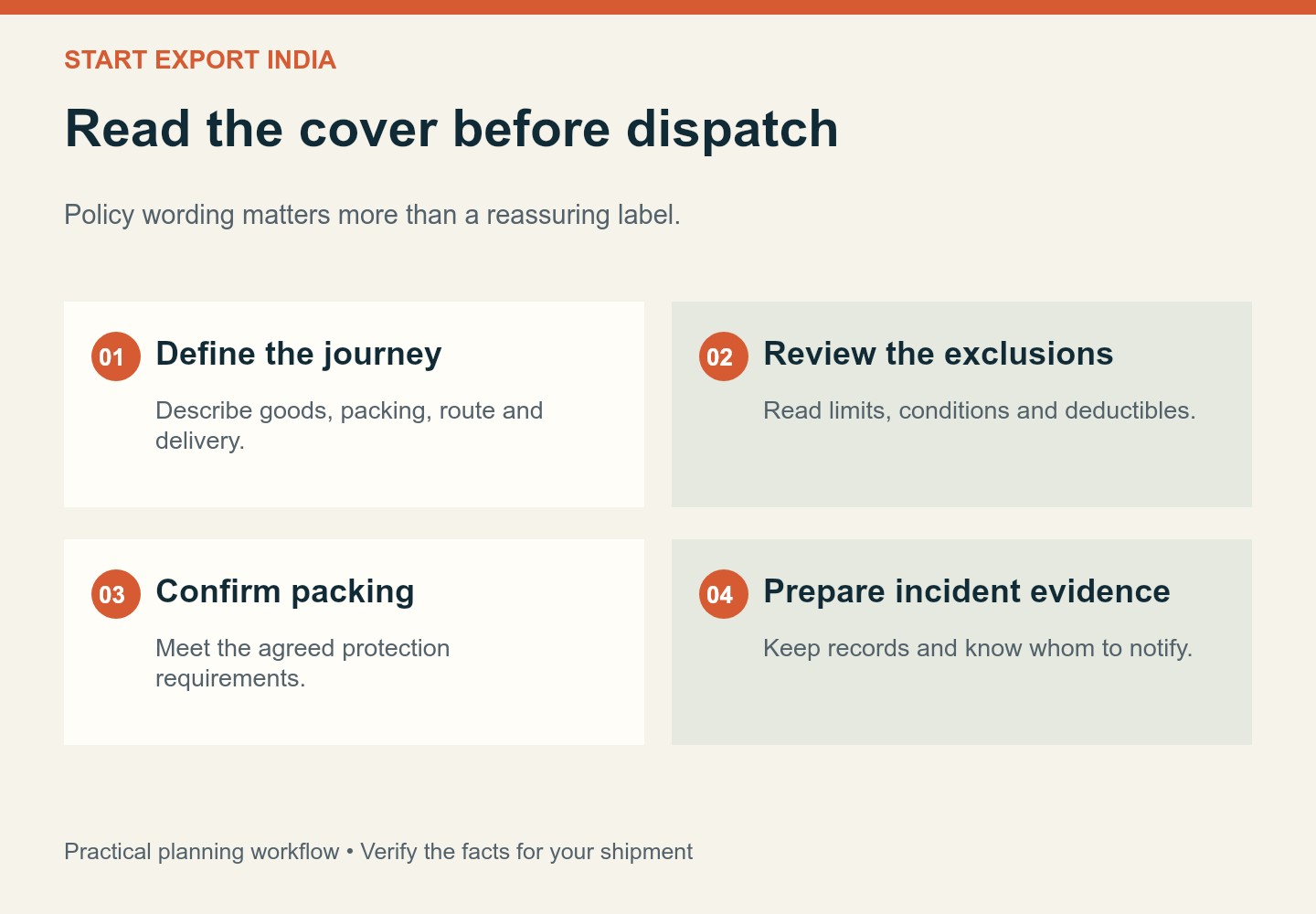
Separate cargo cover from carrier liability and buyer-payment protection
Three different questions are often compressed into “Is the shipment insured?” First, what physical loss or damage is insured under the cargo policy? Second, what liability might the carrier or service provider have under its contract? Third, how is the exporter protected if the buyer does not pay?
Those questions need separate answers. A cargo policy is not automatically a credit-insurance policy. Carrier liability is not the same as reimbursement for the complete invoice value. Use distinct rows in your order file so one positive answer does not conceal a gap elsewhere.
Define the insured journey accurately
Describe the origin pickup, any warehouse or consolidation stage, main carriage, transshipment where relevant and final delivery boundary. Ask when cover attaches and ends, and what happens if routing or storage changes. Do not assume every intermediate activity falls within an informal “warehouse to warehouse” description.
Provide the product, condition, packaging, quantity, value basis and special handling requirements accurately. Used machinery, moisture-sensitive goods, temperature-controlled products and other specialised cargo can require particular conditions. The provider needs the real facts before offering or confirming cover.
Read the exclusions, not just the headline
Maersk's explanation of all-risks cover makes a useful general point: the label does not mean every conceivable risk is insured. Its cargo-insurance contract material provides examples of exclusions and conditions. These are provider-specific materials, not the wording of your own policy.
Ask your adviser to explain the actual exclusions, warranties, excess or deductible, valuation basis, territorial conditions, notification duties and document requirements. If a risk is important to the sale, request written confirmation of its treatment. Do not infer cover from the absence of a warning in a salesperson's message.
Use a pre-shipment insurance review sheet
| Review item | Question for the insurer or broker |
|---|---|
| Insured party and interest | Who is insured and how does the interest match the sale? |
| Goods and packaging | Is the exact cargo accepted with the planned packing? |
| Route and handling | Are the relevant transport and storage stages within scope? |
| Amount and currency | What valuation basis, limit and deductible apply? |
| Important hazards | How are moisture, breakage, theft or temperature concerns treated? |
| Sale requirement | Does the cover meet the actual contractual insurance obligation? |
| Incident response | Who must be notified, how quickly, and what must be preserved? |
The questions are deliberately broader than a premium comparison. A cheaper quotation can be unsuitable if its protection does not match the shipment.
Align the insurance review with packing decisions
Ask whether the policy imposes packaging, survey, securing or handling conditions. Then confirm that the supplier and logistics provider can meet them. An insurance review performed after cargo is sealed may arrive too late to change a material packing weakness.
Keep dated photographs of the goods, inner protection, outer packaging and loading or securing where appropriate. Record the source and condition of the packaging and the people responsible for inspection. Read the export-packaging checklist to connect these records to the actual dispatch process.
These records do not guarantee claim acceptance. They help establish facts and reduce reliance on memory if the shipment later needs investigation.
Plan the buyer's receiving procedure
Discuss with the buyer who will inspect the cargo, record exceptions and contact the relevant parties if damage is observed. Ask the insurance provider what the receiver should do before disposing of packaging, moving damaged goods or arranging repairs. Safety and loss-mitigation actions should follow appropriate professional instructions.
Agree a contact list that includes the exporter, buyer, carrier or forwarder and insurer or broker. Keep it accessible to the receiving team. A person discovering damage should not have to search an old sales conversation for the name of the claims contact.
Worked example: damaged cartons on arrival
Consider a fictional shipment of 120 cartons of ceramic products. The receiver observes visible damage to eight cartons. The order's insurance file identifies the broker and the policy's notification procedure. No assumption is made here about whether the damage is covered.
The receiver records the carton identifiers, visible condition and the time of discovery, retains relevant packaging where appropriate, and follows the provider's instructions for notification and further inspection. The exporter gathers the invoice, packing list, transport documents, dispatch records and the relevant correspondence.
Now compare a weak response: the receiver disposes of all packaging, repairs or discards goods without obtaining instructions, and reports only a total loss figure several weeks later. The evidence may be much harder to reconstruct. The lesson is to establish the response process before shipment, not to assume that every documentation gap can be repaired afterwards.
Record the actual quantities affected separately from estimates. If some goods can be inspected or salvaged, obtain the appropriate instructions. Do not inflate a loss figure to match an order total or present unverified repair costs as confirmed invoices.
Keep a claim evidence register
Create a register with document name, custodian, date, version and purpose. Typical enquiries may concern commercial value, package count, route, timing, condition before dispatch, condition at delivery and the incident itself. The actual insurer's requests determine what must be supplied.
Save communications about survey arrangements, mitigation, repair, disposal and recoveries. Coordinate with qualified advisers about rights against service providers and any relevant deadlines. Avoid promising the buyer a settlement date before the insurer has reviewed the facts.
After the case is resolved, use the findings to improve packing and receiving procedures. Insurance should sit within a wider control process, not become a reason to ignore preventable handling risks.
Frequently asked questions
Does all-risks cover every delay or commercial loss?
No. Review the actual policy. Labels do not override exclusions or conditions, and consequences such as delay or lost sales need careful examination.
Is freight-forwarder liability enough?
Do not assume it provides the same protection as cargo insurance. Review the provider's contract and your insurance needs separately.
Does CIF settle the insurance question completely?
It establishes specified obligations under the selected rule, but the actual cover still needs review. See the Incoterms comparison and your sale contract.
Can I buy cover after damage is discovered?
Do not assume a later purchase can protect a known incident. Discuss when and how cover must be arranged before the shipment with the insurance professional.
Your next step
Complete the review sheet, obtain the policy wording and distribute the incident contact process before cargo moves. Keep insurance costs and scope consistent with your export cost sheet.