
FOB, CIF and FCA describe different delivery arrangements under the Incoterms rules. They help allocate specified responsibilities, costs and risks between buyer and seller. They do not, by themselves, decide payment timing, ownership transfer or every contractual issue. An Indian exporter should choose a rule that matches the actual cargo handover, transport method and service scope.
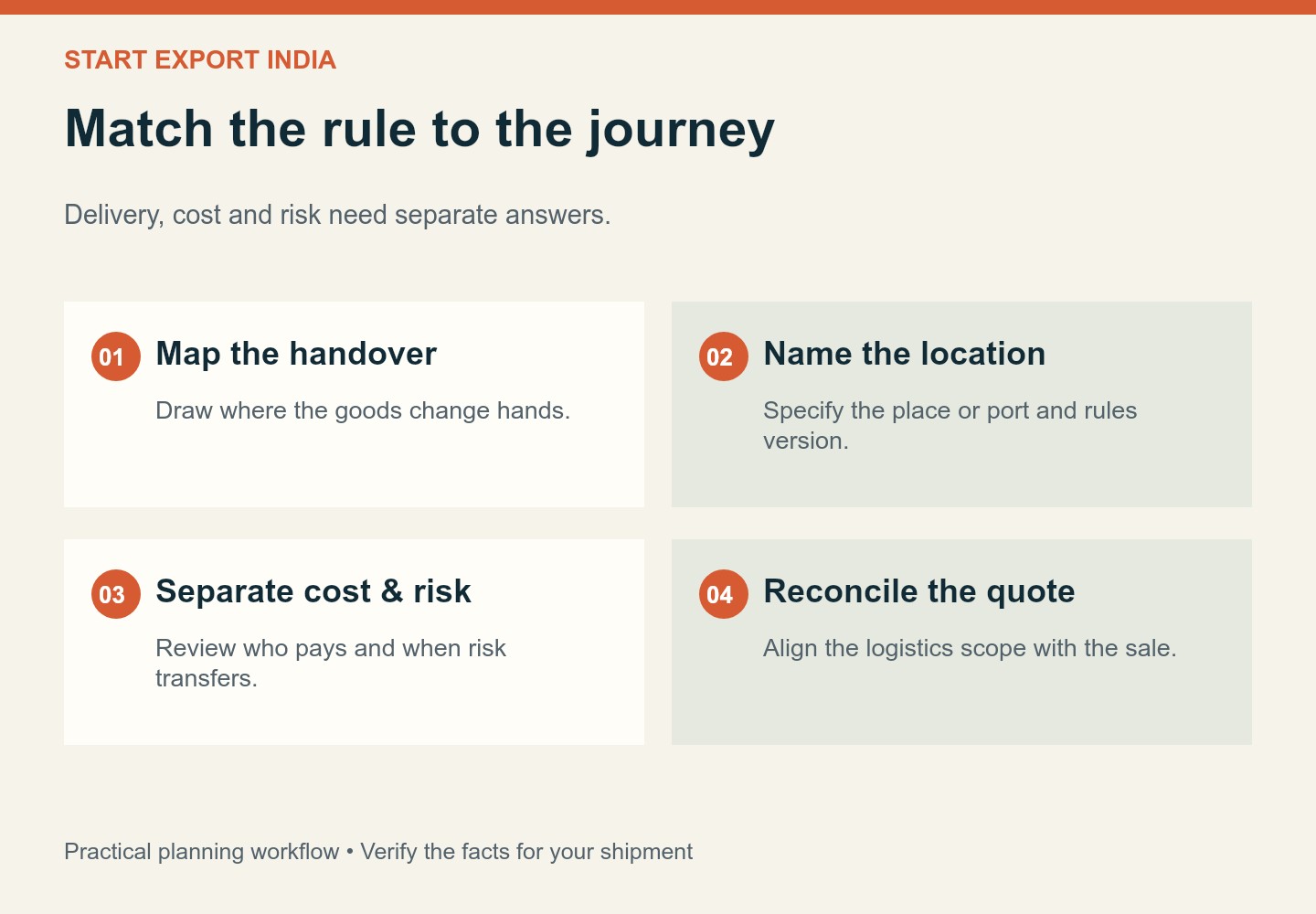
The practical starting point is a movement map: factory, pickup, terminal, main transport and destination. Mark who controls each handover before choosing an abbreviation. This guide explains a review method; the published ICC rules and your actual sale agreement remain essential.
Start with the exact named place and version
“FCA India” is much less precise than a defined delivery location agreed by both parties. A quotation should identify the chosen rule, the named place or port as appropriate, and the applicable version. Otherwise two teams may attach different assumptions to the same three letters.
The International Chamber of Commerce publishes the Incoterms rules. Its selection checklist is a useful starting point when comparing rules with a logistics professional. A simplified online diagram cannot replace the complete rule text.
Understand the important distinction between cost and risk
The point at which a seller pays transport costs is not necessarily the point at which transit risk transfers. This is especially important with rules under which the seller arranges or pays main carriage but delivery occurs earlier. Read the delivery and risk provisions alongside the cost provisions.
For each leg, ask two separate questions: who must arrange or pay for the service, and who bears the relevant risk at that stage? A quotation comparison that has only one column marked “seller responsibility” can conceal this distinction. Keep insurance, carrier liability and payment protection in separate rows too.
FCA: examine the actual carrier handover
FCA can be relevant to containerised or multimodal movements. The precise delivery obligations depend on the named place and the rule. Agree the loading, receiving and handover arrangements with the parties involved rather than assuming that all FCA locations operate identically.
Ask the forwarder to describe how your cargo will move from the supplier to the nominated carrier or receiving point. Identify the evidence that will show the handover occurred. Then compare that physical sequence with the quotation and any banking-document requirements. If a bank requires particular transport-document wording, involve it before finalising the sale arrangement.
FOB: confirm that the sea-transport handover fits
FOB is a sea and inland-waterway rule. ICC's checklist distinguishes direct loading of general or bulk cargo on a vessel from many container-terminal handovers. Do not choose FOB simply because it is familiar in your product trade; check whether the rule matches the movement you can actually control.
A container may be delivered to a terminal before it is loaded on the vessel. Discuss that gap with the buyer and logistics adviser. Clarify which party controls the carrier booking, terminal instructions and information flow. A short quotation abbreviation should not create a responsibility that your operations team cannot perform or verify.
CIF: check the voyage, insurance and delivery point separately
CIF is also a sea and inland-waterway rule. It includes specified seller obligations relating to carriage and insurance, but it should not be read as a promise of delivery to the buyer's warehouse or insurance against every possible loss. Review the exact cover and destination cost boundaries.
Ask what is included in the carrier or forwarder quotation and which charges may remain at destination. Reconcile the insurance arrangement with the cargo, route and sale requirement. If the buyer needs more extensive protection or an inland leg, document how that requirement is met instead of assuming the letters CIF provide it automatically.
Use a responsibility matrix before comparing prices
| Order element | Question to resolve | Evidence to retain |
|---|---|---|
| Delivery point | Where does the selected rule place delivery? | Rule review and precise named location |
| Pickup and loading | Who arranges each activity? | Supplier and provider confirmation |
| Export formalities | Who supplies information and completes the required work? | Agreed responsibility record |
| Main carriage | Who selects and contracts the movement? | Booking and quotation scope |
| Transit risk | When does the relevant risk transfer? | Sale terms aligned with the rule |
| Insurance | Who arranges it and what does it cover? | Actual policy or certificate review |
| Destination costs | Which services and charges remain? | Written destination-charge explanation |
The table is a review worksheet, not an alternative definition of the rules. Have the completed version checked for the actual sale.
Worked example: compare two quotations without mixing scopes
Imagine a fictional exporter receives a ₹480,000 production-and-packing cost and a ₹35,000 origin logistics estimate. A second service quotation adds ₹65,000 for a defined main-carriage scope. These invented figures illustrate how scope changes a comparison; they are not current freight rates.
An offer excluding the main-carriage scope cannot be compared directly with one including it. First create a common cost boundary. Then identify who arranges each service and where delivery and risk transfer under the selected rule. Do not “convert” an offer by adding ₹65,000 while leaving every other responsibility unexplained.
Suppose destination handling is unconfirmed. Put it in an unresolved row, identify the party expected to pay and request written clarification. A lower visible subtotal can still conceal costs that matter to the buyer. Use the export costing guide to keep the commercial arithmetic consistent.
Four mistakes that create avoidable disputes
Using a port name without sufficient precision. Confirm the location and operational boundary with the provider; do not assume that a city name identifies every relevant charge.
Treating the rule as a payment clause. Specify payment amounts and triggers separately. “FOB” does not answer when your buyer must pay the balance.
Confusing insurance with full recovery. A claim depends on cover and conditions. See the cargo-insurance checklist before relying on a sales label.
Copying the supplier's term into the buyer quotation. Your purchase and resale can involve different locations, parties and services. Review both agreements and the gap between them.
Frequently asked questions
Is FOB always suitable for a container shipment?
Do not assume so. ICC's selection material points to FCA for many container or multimodal handovers. Review the actual receiving and loading process with your logistics adviser.
Does CIF mean the seller bears risk until the cargo arrives?
Do not infer the risk point from the fact that the seller pays for carriage. Review the rule's delivery and risk provisions separately from the cost allocation.
Can I use an Incoterm without naming a place?
That leaves an important operational detail unclear. Identify the appropriate named place or port, plus the rules version, in the agreed sale wording.
Do Incoterms settle ownership and disputes?
They do not provide a complete sale contract. Payment, ownership, specifications, remedies and dispute arrangements need their own agreement and, where appropriate, legal review.
Before sending your next offer
Draw the cargo journey, complete the responsibility matrix and reconcile it with the freight-forwarder quotation and pro forma invoice. Resolve gaps before presenting a final price.