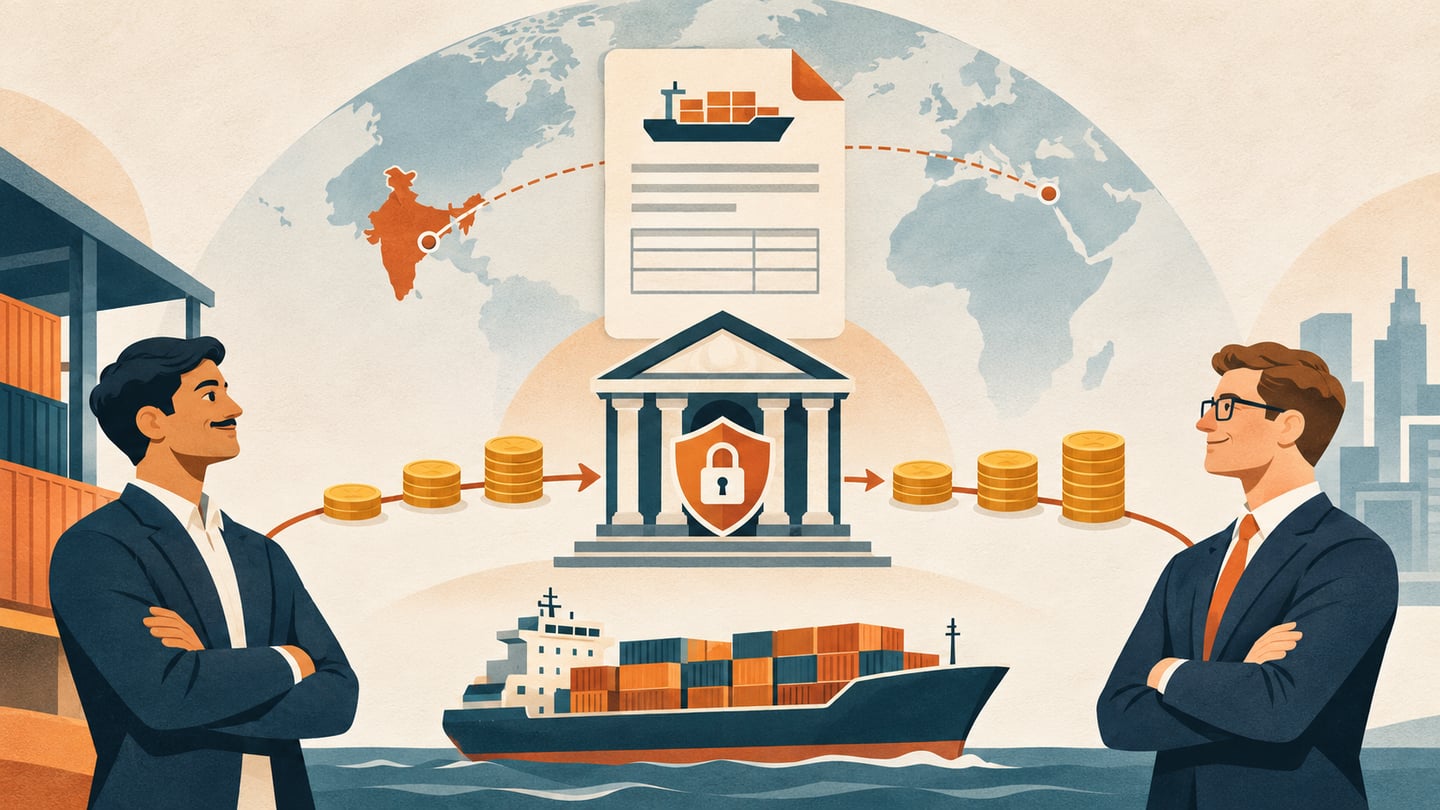
Choose your export payment term by asking one question first: how much of your own cash is at risk between the day you start producing and the day money reaches your bank? Advance payment puts the least of your cash at risk, open account the most, and a letter of credit or documentary collection sits between them.
Illustration (hypothetical): a buyer you have not dealt with before offers payment 30 days after delivery on a first order. The exporter works out that ₹4,20,000 of their own cash would be at risk, so they counter-offer a part advance with the balance against documents. The point is the order of questions: how much cash is at risk, and what evidence triggers payment.
The four terms side by side
| Term | Who carries the risk | When it tends to suit | Check before agreeing |
|---|---|---|---|
| Advance payment | The buyer, until goods arrive | New buyer, custom or made-to-order goods | That funds are received and usable at your bank, not just a transfer screenshot |
| Letter of credit (LC) | Shared, and depends on the issuing bank and the exact wording | Larger first orders, new markets | That you can produce every required document, exactly as worded, before the deadlines |
| Documentary collection (D/P or D/A) | Mostly you, because banks handle documents but do not guarantee payment | Buyers you know, goods that can be resold if refused | What happens to the cargo if the buyer does not pay or accept |
| Open account | You | Established buyers with a record of paying | Your own limit on unpaid exposure, and whether credit insurance is worth it |
This table is a starting point, not a ranking. Country, bank and buyer risk can change the answer.
Separate the method from the trigger
A bank transfer tells you how money moves, not when. Write the trigger as an event you can prove: “30 days from the invoice date” is different from “30 days after the buyer accepts delivery.” If acceptance is the trigger, say who accepts, what they check and what happens if they never respond.
Advance payment
An advance reduces the cash you fund, but you must still deliver exactly what was agreed. Confirm in writing how the advance is applied, when the balance is due and what happens to any customised packing or tooling cost if the order is cancelled. Ask your bank which inward remittance evidence you will need for your records.
Treat any message that suddenly changes the beneficiary account or asks you to pay an unrelated “agent” as a red flag. Confirm by phone with a number you already had.
Before you start production on an advance, confirm in writing the exact amount received in your account, the currency, any charges deducted and the date the funds became available. Decide your minimum acceptable advance before you quote, so you are not deciding it under pressure.
Letter of credit
An LC is only as useful as your ability to comply with it. LCs are commonly issued subject to the ICC’s UCP 600 rules (ask your bank to confirm which rules apply to yours), and payment depends on a complying presentation: the documents must match the credit’s wording, not what you think was meant. A misspelt name or a late shipment date can be enough for a bank to refuse.
Before you accept one, send the draft to your bank and check:
- who the issuing bank is, and whether you need a confirming bank
- the documents required, who issues each one and how long each takes
- the latest shipment date and the presentation period after it
- every charge and who bears it
Ask for amendments before you ship, not after.
Illustration of a discrepancy (hypothetical): the credit asks for the goods to be described as “Cotton Kitchen Towels, 50 x 70 cm”, but the invoice says “Cotton Towels 50×70”. A bank can treat that as a discrepancy and refuse to pay. The fix is to copy the credit’s wording exactly, or to ask for an amendment before you ship.
Documentary collection: D/P and D/A
Under D/P (documents against payment, also called cash against documents), the buyer’s bank releases documents when the buyer pays. Under D/A (documents against acceptance), it releases them when the buyer accepts a bill payable later, which is credit. In neither case does the bank guarantee payment.
If the buyer refuses, the goods may sit at the port. Before you ship, know who can decide at the destination, what storage costs per day, and whether you could resell the goods nearby.
Open account
Open account means you ship first and are paid later, so set your own rules in advance: a maximum unpaid amount per buyer, and a review before a second shipment while the first is unpaid. Count everything the buyer owes you together: unpaid invoices, goods in production and goods in transit. ECGC offers export credit insurance in India; read its limits and exclusions before relying on it.
Measure your cash at risk
Before you agree any term, work out one number:
cash at risk = cash you have spent − cash you have received
For example, if you have spent ₹4,20,000 on goods and packing and received an advance of ₹1,80,000, ₹2,40,000 of your own money is at risk until the balance arrives. Run the same sum for each term the buyer proposes.
The same sum shows how much an advance changes your exposure. Illustration (simple figures): if an order costs ₹4,20,000 to produce and sells for ₹6,00,000, a 50% advance of ₹3,00,000 leaves ₹1,20,000 of your cash at risk, while open account with no advance leaves the full ₹4,20,000 at risk.
Check the time limit for receiving the money
Under the 2026 changes to the FEMA export regulations, the general period for realising export proceeds is nine months from the date of export, down from fifteen. EY’s alert and K S & K’s summary agree on nine months but give different notification and effective dates. Confirm the date, any extension and any exemption that applies to you with your authorised dealer bank, and read the RBI’s own text before you rely on it for open-account terms.
Questions to put to your bank
- Which payment instruments does the bank recommend for this buyer and country?
- What are the charges, and who bears each?
- What documents does the bank need from me for each term?
- What is the current time limit for realising proceeds?
Frequently asked questions
Is a letter of credit always the safest term? No. It protects you only if you comply exactly with its terms, and the issuing bank still matters.
Is D/P safer than D/A? Generally D/P is safer, because documents are released only against payment. Neither carries a bank guarantee.
Should a new exporter accept open account? Rarely for a new buyer. Start with advance or an LC and move to credit once the buyer has paid on time.
Payment terms often go together with the delivery term you quote; see our guide to FOB, CIF and FCA.
By Dinesh Aswani, Start Export India. Updated 17 November 2026. This is general information, not banking or legal advice. Confirm the terms of your own transaction with your authorised dealer bank.
Sources: the U.S. International Trade Administration’s Trade Finance Guide, written for US exporters and used here only for how each payment method works; ECGC for export credit insurance in India; EY and K S & K for the 2026 change to the realisation period.