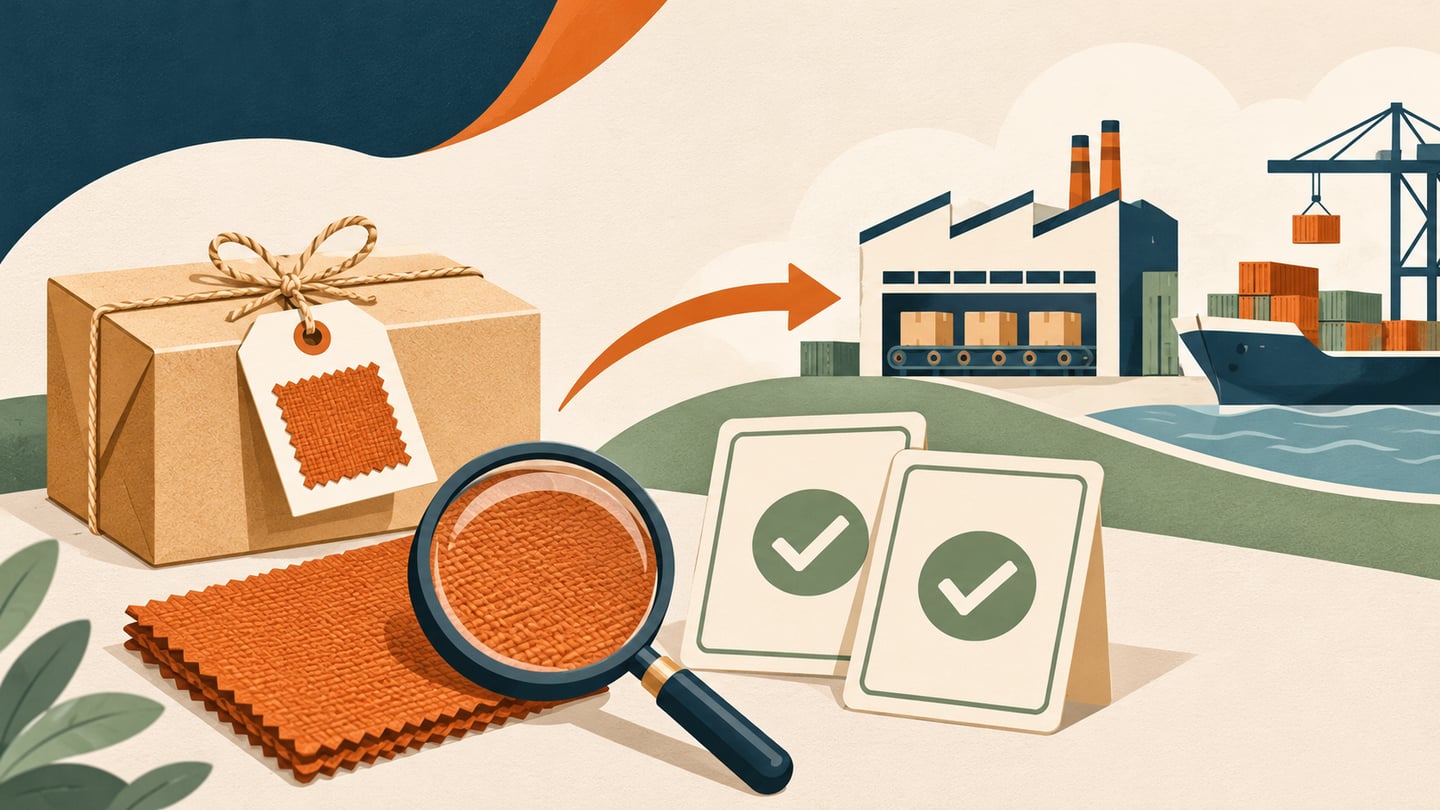
To send an export sample from India, agree with the buyer what the sample must prove and who pays, then declare it to customs truthfully, with a real value even when it is free of charge. A sample is still an export, so the same questions apply: is the product freely exportable, which entry does it go under, and does the destination restrict it?
This guide is a planning framework. Where it uses an example, the example is labelled as an illustration and uses simple figures. The legal points below come from a law-firm summary, so check the current rule for your product with your customs broker, courier or the official CBIC and DGFT pages before you ship.
1. Decide what the sample must prove
A sample should answer one question for one buyer: does the colour match, does the stitching hold, does the pack fit the shelf? Write that question down and agree it before you ship. Send the quantity needed to answer it, not a showroom.
Illustration (hypothetical): a buyer wants to judge the fabric and handle attachment of a cotton bag. The exporter sends three identical pieces, each labelled with the specification revision, and the buyer agrees in writing that approval means the three pieces match the specification, not that an order is placed.
2. Check whether the goods can leave as a sample
Freely exportable goods generally do not need DGFT permission as samples, but restricted goods can still need authorisation even as samples, and SCOMET items need specific DGFT authorisation. Food, medicines and plant products can also fall under their own regulators, such as FSSAI, CDSCO and plant quarantine. Check the destination country too: some destinations are restricted. Confirm each point for your product before you pack anything.
3. Choose the route and the entry
Exports need an entry under Section 50 of the Customs Act, 1962: a shipping bill for sea or air, a bill of export for land. Couriers handle much of the paperwork for small parcels, but you remain responsible for an accurate description and value. If someone carries samples in their baggage, they must be bona fide and declared at departure.
| Route | Who usually handles the paperwork | Check before you choose |
|---|---|---|
| Courier | The courier prepares the entry from your invoice | That the courier accepts your goods and destination, and what it needs from you |
| Cargo through a forwarder | Your customs broker or forwarder | Cost and timing for a small shipment |
| Passenger baggage | The traveller declares at departure | Letters and proof that the samples are for business demonstration |
4. Declare a real value, even when the sample is free
A free sample still needs a customs value on the invoice. A nominal or arbitrary figure can draw scrutiny, so ask your customs professional or courier how to state it. Do not write a value just to lower charges.
5. Build the sample cost sheet
List the sample cost, packing, courier or freight, documentation, import charges if you agree to pay them, and your time. Agree in writing who pays each line and what happens to a sample that is lost or held by customs.
Illustration (simple figures, not a quotation): three samples at ₹400 each cost ₹1,200, packing is ₹400 and the quoted courier charge is ₹2,800, so the total is ₹4,400 before any excluded charges. If the buyer agrees to bear the courier charge, your own cost is ₹1,600.
6. Pack the reference, not just the product
Include a printed specification sheet, a label with the sample code and a card saying what the buyer should evaluate. Keep an identical set at your end so both sides discuss the same item.
7. Record approval and the next step
Ask the buyer to confirm in writing: sample received, what was checked, approved or changes needed, and the next step. Keep the courier receipt and correspondence in the order file. Our shipping bill checklist shows how to keep the export file together.
Common mistakes
- Writing “no commercial value” or a token figure to avoid charges.
- Treating a delivered sample as an order.
- Shipping without agreeing who pays freight and import charges.
- Forgetting the destination’s rules for the product category.
Frequently asked questions
Do I need an IEC to send samples? The IEC is required for most exports under the Foreign Trade (Development and Regulation) Act. The source I used does not say whether samples are exempt, so confirm with your customs broker or DGFT.
Can I send free samples by courier? Generally yes for freely exportable goods, with an accurate description and value. Confirm the courier’s own acceptance rules.
How many samples should I send? Enough to answer the buyer’s question, and no more.
If you want templates for the buyer follow-up, the Export Starter Toolkit includes editable buyer messages.
By Dinesh Aswani, Start Export India. Updated 17 November 2026. This is general information, not legal advice. Confirm the rules for your own goods with your customs broker or the authorities.
Sources: Bhatt & Joshi Associates, Export of Product Samples in India for the legal framework, which is a law-firm summary and should be checked against current CBIC and DGFT instructions.