
A shipping-bill review should connect the customs declaration with the actual goods, commercial documents and chosen transaction arrangements. For an Indian exporter, the practical control is a clear master record, a competent review of the draft information and a traceable follow-up after filing. A reference number alone does not show that every detail or subsequent status is correct.
This article is a document-control workflow, not a screen-by-screen filing tutorial or a substitute for customs advice. The applicable process, declarations, permissions and supporting documents depend on the shipment. Use current official instructions and a qualified customs professional.
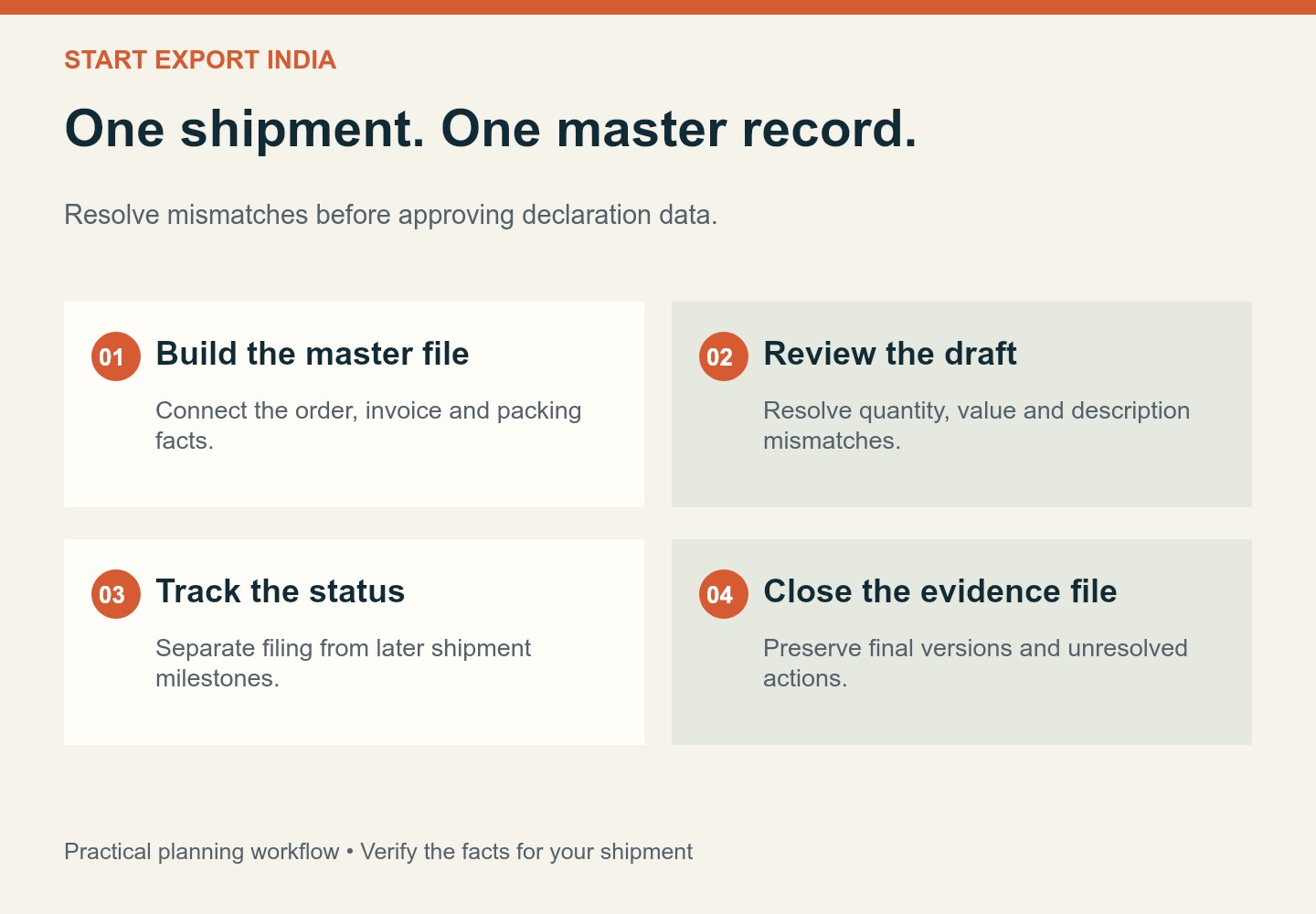
Separate business records from shipment facts
Some information identifies the exporter and its registrations or banking arrangements. Other information describes the particular sale and cargo. Keep the source of each field clear. A previous declaration can be a reference, but it should not silently become the authority for a new order.
Create a master order record with the approved buyer details, product specification, quantities and units, invoice data, packing information, delivery scope and any relevant scheme or regulatory questions. Assign an owner for updates. If the buyer changes the quantity or the supplier changes the packing, the master record needs review before downstream documents are finalised.
Agree who prepares, checks and approves the information
Ask the customs professional what they need, when they need it and which information requires specialist determination. The exporter should understand the facts being declared and resolve discrepancies before approving instructions. Outsourcing preparation does not turn inaccurate supplier data into accurate data.
Maintain a simple matrix: field or document, source, preparer, reviewer and approval date. Use a second review for high-impact facts where practical. A small business can still separate “entered by” from “verified against source” even when an external adviser performs part of the work.
Pre-filing checklist: reconcile the commercial file
| Review area | Compare against | Action if unclear |
|---|---|---|
| Exporter identity | Current business and registration records | Resolve the discrepancy with the responsible professional. |
| Consignee and destination | Accepted sale and buyer instructions | Verify the correct legal and delivery parties. |
| Product description and classification | Technical specification and classification review | Obtain missing product facts; do not guess a code. |
| Quantity and units | Accepted order and actual dispatch record | Investigate differences before copying figures. |
| Value and currency | Final commercial invoice and sale scope | Reconcile adjustments, inclusions and currency. |
| Packages and weights | Final packing and weighing records | Label net and gross figures clearly. |
| Additional declarations | Current applicable requirements | Obtain specific advice rather than copying a prior selection. |
This table identifies control areas. It is not an exhaustive list of statutory fields or supporting documents for every export.
Confirm classification and policy questions before approval
An export declaration should not become the place where an unresolved product classification is casually decided. The HS-code preparation guide explains how to compile the product facts for review. Check relevant export-policy conditions and product-specific requirements through the appropriate official sources.
Likewise, do not select an incentive, tax or other declaration merely because a previous exporter used it. Eligibility and consequences need assessment for your business and transaction. Record the adviser, source and basis of any important determination in the order file.
Worked example: a bag-count mismatch
Suppose a fictional sale concerns 23,000 kg packed in 460 bags of 50 kg net each. Before filing, the packing team reports only 458 completed bags. The physical total would be 22,900 kg, which is 100 kg below the planned quantity.
The correct action is to establish the source facts. Perhaps two bags remain to be packed, perhaps a count is wrong, or perhaps the dispatched quantity will change. Do not amend one document just to preserve the appearance that the original order was fulfilled exactly.
Once the facts are confirmed, coordinate the commercial and document changes with the buyer and relevant professionals. Review the invoice, packing list, shipping instructions and declaration data together. Keep the discrepancy, decision, reviewer and revised versions in the file. The exercise is an original teaching example, not a report of an actual shipment.
Save the filed record and track the relevant statuses
After filing, obtain the relevant reference, date and location details and the final version of the documents. Confirm with the customs professional which subsequent statuses or actions must be tracked for the actual shipment. A filed declaration, customs clearance, departure information and later integration or follow-up are distinct events.
How to check shipping bill status on ICEGATE
- Have the shipping bill number, shipping bill date and customs location code from the filed record ready.
- Open ICEGATE’s enquiry services. In Public Enquiries, choose Document Status → Shipping Bill. Select the customs location, enter the number and date, then search.
- Read the result for the milestone you need. Shipping Bill Details identifies the filed declaration. Current Status can show the Let Export Order (LEO) date, which records customs clearance for export. EGM Status shows information about the carrier’s Export General Manifest. A shipping bill number or an LEO date alone does not confirm departure.
- If you specifically need to check transmission to DGFT, use the separate DGFT Shipping Bill Status Enquiry in Public Enquiries. Enter the same location code, number and date. If an error code appears, record it and ask your customs broker or the ICEGATE helpdesk which record needs attention.
See sections 5.6.4 and 5.7 of the ICEGATE 2.0 Public Enquiries manual.
Record the enquiry date and what the result actually says. A status display can help identify a question for the responsible professional; it should not be expanded into an unsupported claim that every customs, banking or tax obligation has been completed.
Use the free checklists for export IGST refund troubleshooting and RoDTEP claims and e-scrips to record what you find after filing.
Handle corrections through the authorised process
If an error is discovered, explain it promptly to the customs professional and ask about the applicable correction or amendment procedure. Do not alter an issued document locally and circulate it as though the official record had changed.
Keep the original record, the requested correction, supporting evidence, the authority or professional's response and any updated record. Identify which parties need the corrected version. If the issue could affect banking or other follow-up, coordinate those consequences separately rather than assuming a single amendment automatically updates every system.
Close the order file after departure
Bring together the final invoice, packing record, transport document, customs records, delivery communications and payment follow-up. Ask the authorised dealer bank and accountant which records and actions apply to the transaction. General document organisation does not replace their current requirements.
Use a closure checklist with completed, unresolved and not-applicable statuses. “Not applicable” should include a reason or adviser reference. If an unresolved item remains, assign an owner and next action. This is more useful than a folder labelled “shipment done” while questions are still open.
Frequently asked questions
Can I use the previous shipping bill as a template?
It may help identify familiar fields, but every shipment's facts and applicable declarations need review. Do not copy values, classifications or scheme selections without verification.
Is a shipping-bill number proof that the goods departed?
Do not treat every stage as the same event. Ask which official records and statuses establish the relevant milestone for your shipment.
Who should correct an error?
Use the authorised process with the customs professional and relevant authority. Preserve the evidence and version history rather than manually editing the official-looking document.
Does this checklist cover every required document?
No. Product, destination, transport and transaction arrangements can add requirements. Use it alongside a shipment-specific professional review.
Your next step
Use the broader export-document checklist to build the master file, then make shipping-bill draft approval and post-filing follow-up explicit milestones in your dispatch plan.