A Certificate of Origin (CoO) documents where exported goods originate under the rules that apply to the shipment. A buyer, importing customs authority or bank may ask for it. For exports from India, confirm the reason for the request before choosing a certificate type.
A preferential CoO supports a claim for reduced import duty when the goods meet the applicable trade agreement’s rules. A non-preferential CoO documents origin for a customs, commercial or banking requirement without supporting a tariff preference. Dispatch from India alone does not establish Indian origin. Use the eCoO 2.0 application steps below once you know which type you need.
Distinguish origin from the shipping location
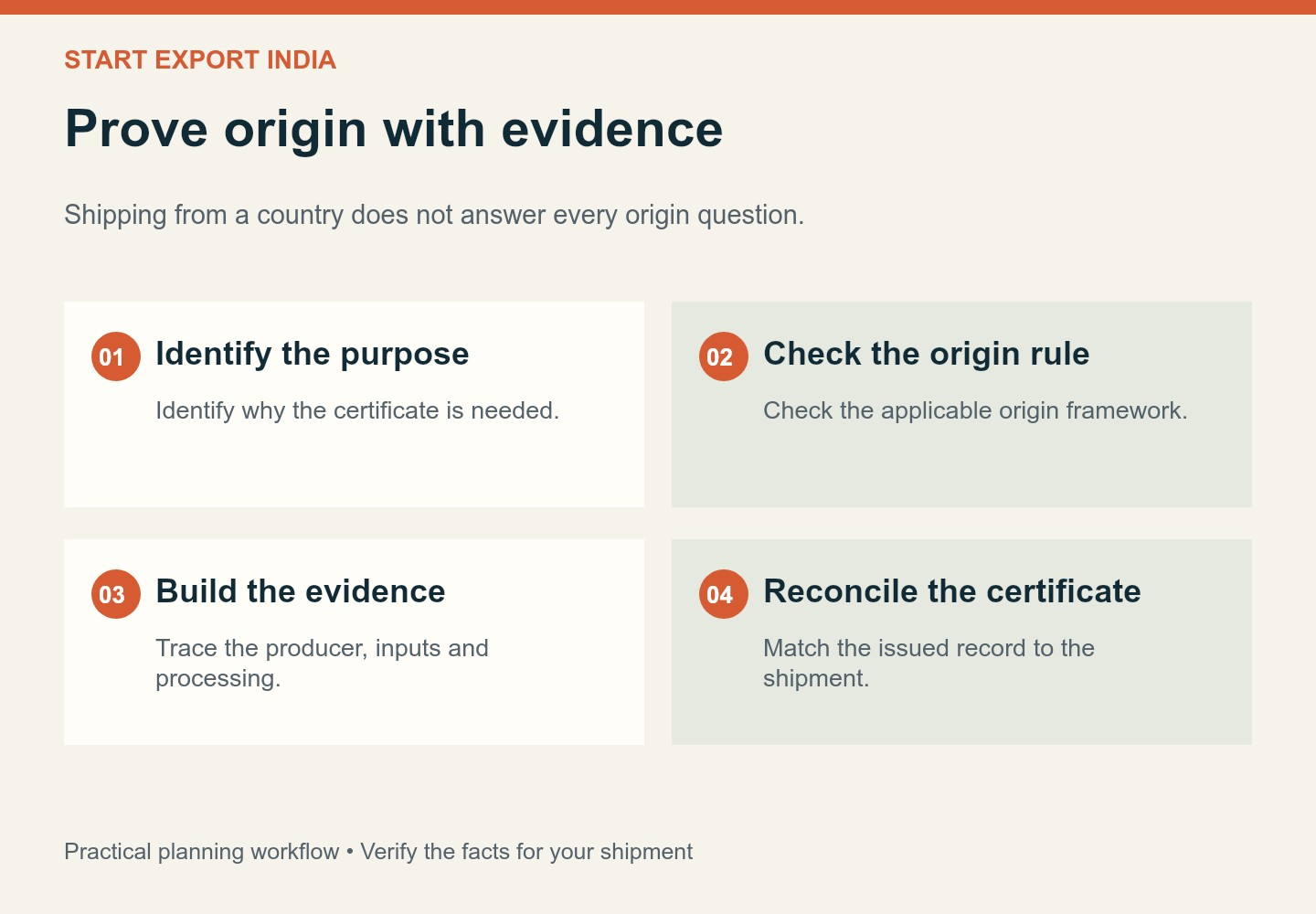
Origin concerns the goods and the relevant origin framework. A dispatch address identifies where a shipment begins. A trader can ship goods bought from another country, while a manufacturer may use imported inputs in a finished product. Those facts require analysis rather than a conclusion based solely on the exporter's location.
Begin with a manufacturing and sourcing description. Identify the producer, the material inputs, the processing performed and the supporting records. Ask the appropriate issuing body or qualified adviser which facts and documents are required for the particular certificate. Do not substitute a generic supplier assurance for an origin assessment.
Preferential and non-preferential certificates serve different purposes
The ICC's guide for customs and importers distinguishes the two certificate types. Preferential origin relates to eligibility under an applicable preferential arrangement; a non-preferential certificate does not establish a tariff preference simply by existing.
| Question | Preferential context | Non-preferential context |
|---|---|---|
| Why is the evidence requested? | To support a preference claim under the relevant arrangement. | To support an origin declaration for the requested commercial or regulatory purpose. |
| What must be reviewed? | Applicable agreement, product rule and other claim conditions. | Relevant origin framework and issuing requirements. |
| Is dispatch from India sufficient? | Do not assume it satisfies the origin rule. | Do not assume dispatch establishes origin. |
| Who confirms acceptance? | Relevant issuing and importing authorities under the arrangement. | Relevant issuing body and destination requirements. |
Avoid describing any certificate as a universal guarantee of lower duty. The importing authority's applicable rules and the correctness of the claim matter.
Identify the requirement before applying
Ask the buyer for the precise document request and the reason it is needed. If a bank instrument requires a specified form or issuer, have the bank review that wording early. A certificate useful for customs may not satisfy a differently drafted documentary condition.
Record the destination, product description, proposed classification, invoice reference and any agreement being considered. Then confirm the authorised issuing route. India's eCoO 2.0 announcement describes the upgraded digital system and associated features. Use the current official trade portal for the relevant service and current instructions rather than relying on old screenshots of a retired workflow.
How to apply for a Certificate of Origin on eCoO 2.0
Use Trade Connect for new applications for either type. Sign in with your DGFT exporter credentials. If you are new to DGFT, register and link your account to your Importer Exporter Code (IEC). In the Certificate of Origin service, start a fresh application or resume your draft. Confirm the IEC branch for the shipment.
Preferential Certificate of Origin
- Check the agreement and product rule. Confirm the destination, HS code and applicable trade agreement. Check the rule of origin for each item and any shipment conditions under the agreement. Gather supplier or production records that support the claim.
- Select the preferential route. In Certificate Details, choose the preferential type, the applicable agreement and an issuing agency and office listed for that agreement.
- Enter the shipment and origin details. Complete the importer, invoice, product and shipment fields. Provide the origin criterion for each item and enter input or cost details where the chosen agreement and portal require them.
- Attach the supporting documents. Upload the commercial invoice and the other records required by the agreement or issuing agency. These may include a packing list, producer declaration, cost sheet or transport record. Check that the evidence supports the origin criterion you entered.
- Submit and track the application. Follow the signing, payment and tracking steps below. Share the issued certificate with the buyer so their customs representative can review the preference claim.
For ASEAN–India preferential shipments, use the AIFTA Form AI guide and free application checklist.
Non-preferential Certificate of Origin
- Confirm the document request and origin basis. Ask what the buyer, bank or destination authority requires. For a standard Indian-origin certificate, verify the applicable non-preferential origin criteria for the goods.
- Select the non-preferential route. Choose the non-preferential type and the appropriate request type. Select an authorised agency and office from the options the portal provides for this route.
- Enter the commercial and shipment details. Complete the importer, invoice, product, quantity, package and transport fields. Record the origin information requested for each item and check it against the supporting records.
- Upload the invoice and packing list. DGFT’s Handbook of Procedures lists both for online non-preferential applications. Add any other evidence the issuing agency requests.
- Submit and track the application. Follow the steps below, then compare the issued certificate with your invoice, packing list and shipment details before sending it.
Sign, pay and download the issued certificate
- Complete the declaration and review the application summary. Sign using the method available for your registered account, such as Aadhaar e-sign or a digital signature certificate (DSC).
- Pay the amount shown by the portal and keep the receipt and file number.
- Check the submitted file in your dashboard. If the agency asks for clarification or documents, respond against the same file. Download the certificate after it has been issued.
Use the portal prompts for your chosen agreement and issuer. DGFT’s exporter application manual illustrates the common screens using a non-preferential example. See also DGFT’s Handbook of Procedures, Chapter 2, and its eCoO 2.0 trade notice for both certificate types.
Build a traceable evidence pack
Keep the commercial documents and the origin evidence connected but distinct. The invoice identifies the sale; the sourcing and manufacturing records support the origin analysis. One is not automatically a substitute for the other.
A useful preparation pack may include the product specification, producer details, input sourcing information, a manufacturing explanation, supplier declarations where relevant, invoice and packing references, and the applicable rule review. The exact requirements depend on the certificate and transaction. Treat this list as an organising aid, not a complete legal checklist.
If the issuer requests cost or input data, establish who can supply accurate records and how confidentiality will be protected. Do not create unsupported percentages merely to make an application appear complete. Mark the missing evidence and resolve it with the producer.
Worked example: a trader reselling a manufactured product
Imagine a fictional merchant exporter selling cotton bags manufactured by an Indian supplier. The buyer asks whether a preferential certificate can reduce its import duty. The trader has an invoice from the supplier but no information about material sourcing or the applicable product rule.
The trader should first identify the relevant arrangement, if any, and obtain the manufacturing evidence needed for review. The fact that the bags are bought from an Indian company does not answer every origin question. An authority or qualified adviser may need to examine the relevant production facts and conditions.
Until the claim is verified, the trader should not promise a preferential landed price. It can present a transparent estimate with an unresolved preference assumption and ask the buyer's customs representative to confirm the destination treatment. The landed-cost guide explains how to keep that assumption separate from a confirmed tax calculation.
Reconcile the certificate with the shipment
Before releasing documents, compare exporter and consignee information, product description, package details where required, invoice references and origin wording against the approved order file. Investigate a mismatch instead of editing a document simply to make the numbers look consistent.
If the shipment changes after an application, ask the issuer how the certificate should be handled. Do not alter an issued certificate yourself. Keep the original, any permitted replacement or correction and the explanation of what changed. Make sure the buyer and bank receive the correct version through the agreed process.
Verify authenticity through the relevant issuing route
Use the official verification method appropriate to the actual certificate. The ICC verification platform covers certificates within its stated participating arrangements; it is not a universal checker for every origin document worldwide. DGFT and the relevant issuer may provide their own verification routes.
Be cautious about unofficial sites offering guaranteed certificates without reviewing the goods. Check the domain and the issuer's authority through official channels. A downloaded PDF or a convincing stamp image is not, on its own, sufficient evidence that a certificate was properly issued.
Frequently asked questions
Does a certificate of origin guarantee preferential duty?
No. A preference claim must meet the applicable agreement and destination requirements. A non-preferential certificate should not be treated as a preference entitlement.
Can a merchant exporter apply without manufacturing the goods?
Discuss eligibility and evidence with the authorised issuer for the relevant process. A trader may need manufacturing information from the producer; do not assume that a purchase invoice answers all origin questions.
Can I reuse the previous shipment's certificate?
Do not assume that is permitted. Review the certificate's scope and the current shipment with the issuer. Product, invoice and consignment details may differ.
What if the buyer requests a correction?
Establish whether the request is factually correct, then use the issuer's authorised correction procedure. Preserve a version trail and coordinate with any bank involved.
Your next step
Add an origin-evidence row to your export-document control sheet. Assign an owner for the issuer enquiry and resolve the required form, evidence and timing before making a tariff-preference promise.