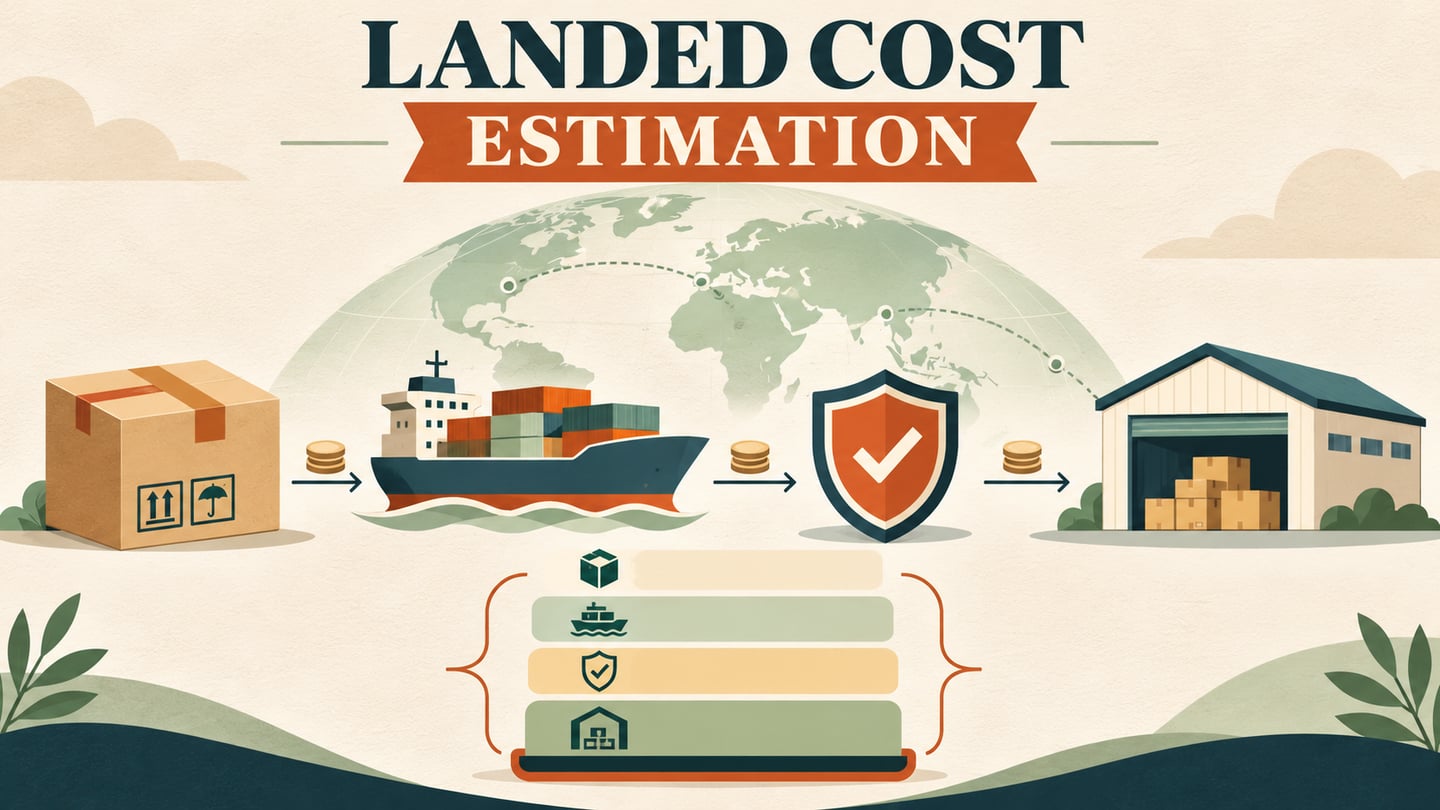
Landed cost estimates the total cost of getting defined goods to an agreed destination boundary. It can include product value, transport, insurance, duties, taxes and other charges, depending on the scope being compared. For an Indian exporter, the useful question is not “What percentage should I add?” but “Which verified costs belong in this buyer's scenario, and who pays them?”
This guide provides a planning method and an invented numerical exercise. It does not calculate a real country's tax liability or recommend a delivery term. Destination classification, valuation and tax treatment need review by the relevant customs professional or authority.
Define the destination boundary before adding costs
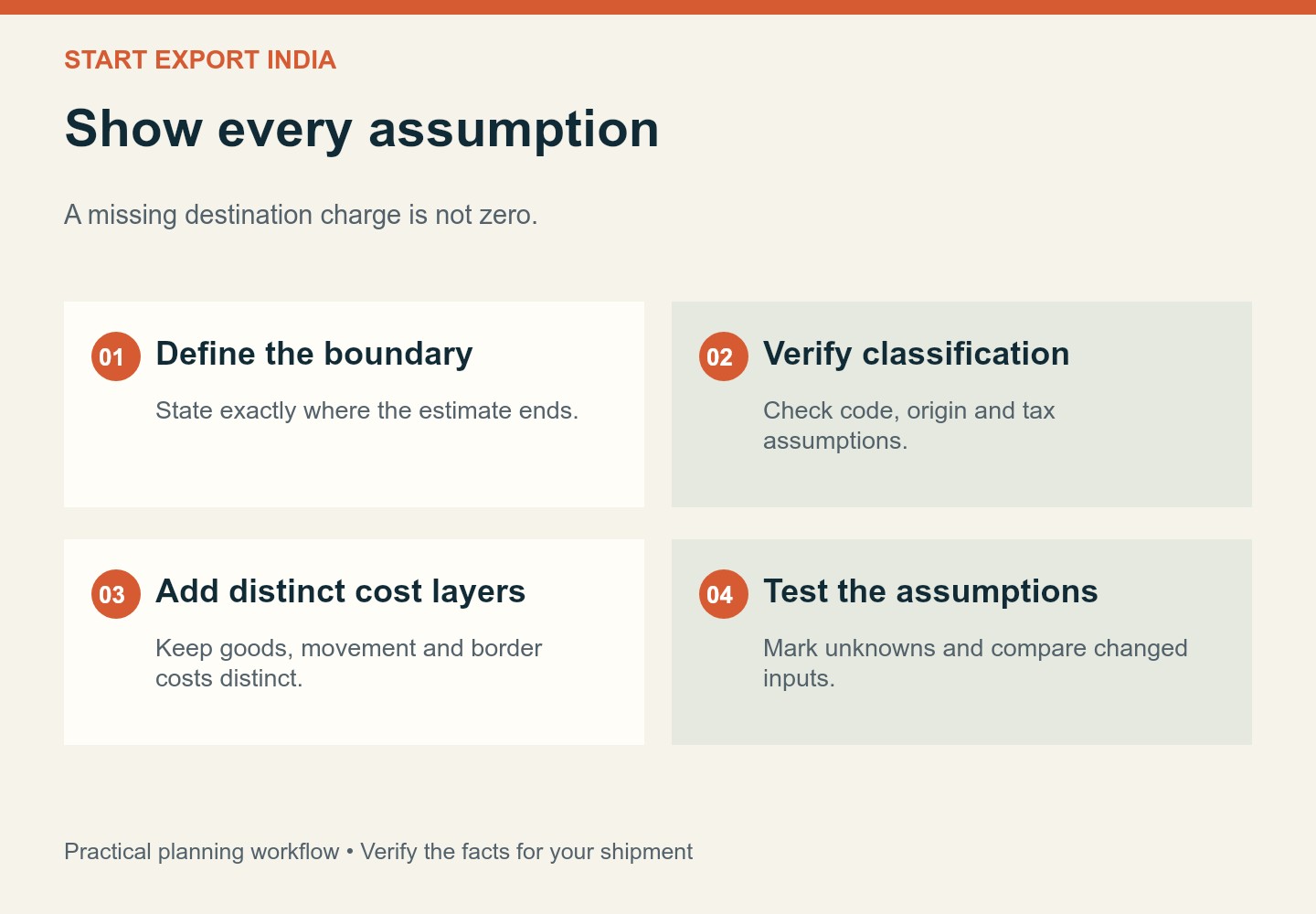
Identify whether the estimate ends at a port, customs release, a named warehouse or another precise location. Then state which services are included. A port-arrival figure cannot be presented as a delivered-to-warehouse total without examining clearance, handling and onward movement.
Separate the estimate from the contractual offer. You might help a buyer understand costs that the buyer will pay directly, even though those costs are not included in your selling price. Label the payer and the commercial scope so the buyer does not mistake a planning worksheet for a promise to supply every service.
Keep four types of number separate
Use clear labels for confirmed quotations, dated estimates, statutory calculations requiring verification and unresolved items. A missing destination charge is not zero. An expired freight rate is not a current confirmation. A tax assumption is not an authority's final assessment.
The International Trade Administration's total-export-price guide explains the broad components of landed cost and the need to describe estimates honestly. That material is written for US exporters; its US-specific classification and preference examples should not be applied automatically to Indian-origin goods.
| Cost layer | Evidence to request | Main review question |
|---|---|---|
| Goods | Accepted quotation or invoice scope | Does the amount already include packing or another service? |
| Origin movement | Comparable logistics quotation | Which pickup, handling and documentation services are included? |
| Main carriage and cover | Freight and insurance scope | Are the route, currency and validity clear? |
| Destination border costs | Qualified destination review | What classification, valuation and tax basis apply? |
| Destination services | Handling, clearance and delivery quotations | Which charges are separate, conditional or buyer-paid? |
Resolve classification and origin assumptions
Before estimating destination duties, establish the relevant destination classification and the facts supporting it. The HS-code guide explains how to assemble the product evidence. Do not choose a code simply because an online tool shows a lower rate.
If a preferential rate is being considered, verify eligibility under the applicable arrangement and the origin evidence required. A shipment leaving India does not automatically qualify for every preference. Read the certificate-of-origin guide and ask the destination customs representative to explain the assumptions used in its calculation.
Avoid counting the same cost twice
Start with a line-by-line description of your selling price. If freight is already included, do not add it a second time as though it were outside the price. Likewise, identify whether an origin service fee already includes a document charge listed elsewhere.
Compare invoices and quotations using a common currency and stated conversion assumption. Record the date and direction of the rate, such as INR per USD. A conversion used for your commercial worksheet may differ from a customs authority's valuation rate. Keep those purposes separate and ask the relevant professional which rate applies to the statutory calculation.
Worked example: a fictional landed-cost scenario
Assume a teaching shipment with goods value USD 10,000, freight USD 1,200 and insurance USD 100. For this exercise only, suppose the relevant valuation basis is USD 11,300, a hypothetical duty is 5% of that amount, and a hypothetical import tax is 10% of valuation plus duty. These are invented assumptions, not rates or rules for any actual country.
| Component | Illustrative calculation | Amount |
|---|---|---|
| Goods | Given | USD 10,000.00 |
| Freight | Given | USD 1,200.00 |
| Insurance | Given | USD 100.00 |
| Assumed valuation basis | 10,000 + 1,200 + 100 | USD 11,300.00 |
| Hypothetical duty | 11,300 × 5% | USD 565.00 |
| Hypothetical import tax | (11,300 + 565) × 10% | USD 1,186.50 |
| Other destination services | Invented combined estimate | USD 450.00 |
| Total cash outlay in this example | Sum of the applicable amounts | USD 13,501.50 |
The example demonstrates arithmetic, not a customs valuation method. A real destination may use different bases, rates, charges, reliefs or procedures. Have those inputs confirmed before relying on the estimate.
Also distinguish cash outlay from final economic cost. A buyer may need advice about whether a particular tax is recoverable and when recovery is possible. Do not remove a tax from the cash plan merely because someone expects it to be recoverable later.
Test the assumptions that could change the decision
Create a base case, a higher-cost case and a smaller-order case. Change identifiable inputs: freight, handling, exchange rate, quantity or an unconfirmed destination fee. Do not add an unexplained percentage and call it a complete risk adjustment.
For example, if the fictional USD 450 destination-services estimate increases by USD 200, the total cash outlay increases by that amount if no other calculation base changes. If freight changes, some destinations' valuation-linked calculations may also change. Confirm the relationships with the relevant professional rather than assuming every cost moves independently.
Smaller quantities can raise landed cost per unit because shipment-level fees are spread across fewer units. Use the FCL-versus-LCL comparison to obtain realistic alternatives and the export selling-price guide to separate your margin calculation from the buyer's import costs.
Present the estimate in a reviewable format
Put the product version, quantity, packing, destination boundary, delivery scope, currency, source dates and validity at the top. Mark each line with its payer and evidence status. Highlight any unresolved item likely to change the buying decision.
Include a statement explaining that actual customs assessments and provider charges can differ from the estimate. Give the buyer a clear next action, such as confirming classification with its broker or obtaining the final delivery quote. Transparency is more useful than a precise-looking total built on hidden assumptions.
Frequently asked questions
Is landed cost the same as my export selling price?
Not necessarily. The buyer's total import cost can include amounts outside your contractual price. State the scope and payer for each line.
Can I use one duty percentage for every destination?
No. Product classification, origin, date and destination rules can change the result. Use current destination-specific advice.
Should recoverable taxes be excluded?
Show the cash payment and obtain advice about recoverability separately. Timing matters even where a later recovery is available.
Can an online calculator guarantee the total?
No. Its output depends on inputs, coverage and assumptions. Verify the underlying classification, rates, valuation and provider charges.
Your next step
Build a dated estimate with visible assumptions and ask the buyer's customs representative to review the destination components. Reconcile the final commercial offer with the Incoterm and named location before accepting an order.