
Finding an HS code begins with describing the actual product, then checking the classification structure and the relevant Indian export policy. A code suggested by a buyer, supplier or marketplace can be a useful lead, but it is not a substitute for a reasoned classification. For uncertain or consequential cases, involve your customs professional and the appropriate authority before quoting or shipping.
This guide shows how to build a classification evidence file. It deliberately does not assign a code to an unspecified product: small differences in material, processing, use or construction can change the analysis.
Understand what HS and ITC(HS) refer to
The World Customs Organization describes the Harmonized System as an internationally organised product nomenclature using six-digit commodity codes. Countries can add national subdivisions. India's DGFT introduction to exporting explains the eight-digit ITC(HS) structure used for Indian trade requirements.
Do not assume that a buyer's complete national tariff code will be identical to the Indian code. Discuss the shared classification basis and the destination's additional digits with the responsible professionals. A code also needs a matching product description; copying digits while describing different goods creates a weak record.
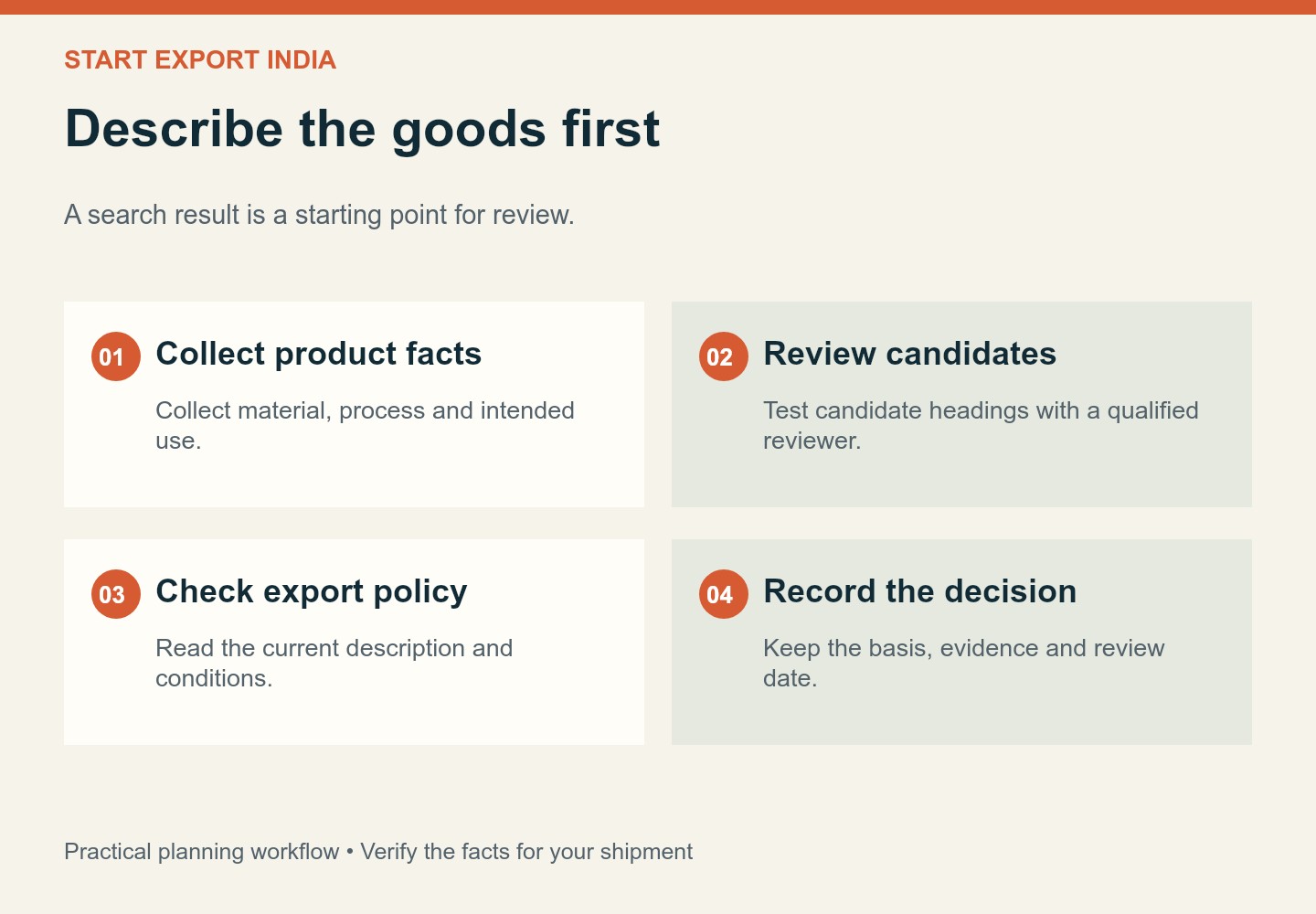
Build the product dossier before searching
A vague description such as “food powder,” “machine part” or “cotton product” is rarely enough to support careful classification. Write down what the item is, what it is made from, how it is processed and what it does. Include photographs, a technical sheet and a manufacturer explanation where useful.
| Evidence field | Useful detail | Why it matters to the review |
|---|---|---|
| Composition | Materials and their proportions, where relevant | Similar-looking products can have different material bases. |
| Processing | Raw, milled, blended, coated, assembled or otherwise transformed | The finished condition may matter. |
| Function | Intended use and operating role | A generic name may conceal a specialised function. |
| Construction | Dimensions, components and how they work together | Sets and assemblies need careful analysis. |
| Presentation | Retail pack, bulk supply, parts or complete article | The product as shipped is the starting point. |
| Supporting records | Dated manufacturer data and sample reference | A reviewer needs traceable facts. |
Do not invent composition percentages to complete the table. Missing information is a task for the supplier or laboratory, not a reason to guess.
Use searches to generate candidates, then test them
Start with the product's objective features rather than the commercial label alone. Record the candidate headings that appear relevant and the reason each is being considered. Review the applicable wording, notes and interpretative framework with a qualified person. A keyword match is not the final classification argument.
For example, two suppliers may call their goods “industrial liners” even though one supplies textile articles and another supplies a different material construction. Searching only the label can push both into the same candidate list. The product dossier helps identify which facts must be established before choosing between candidates.
Keep a rejection column. Recording why a plausible alternative was not selected makes a later review faster and helps the next employee understand the decision. A bare spreadsheet cell containing eight digits provides very little institutional memory.
Check export policy independently of the tariff search
After identifying the relevant classification, check the current Indian export-policy entry, description and conditions through DGFT. Read the applicable notifications and product-specific requirements rather than treating an old downloadable list as complete. DGFT's general notes to export policy provide context for reviewing the schedule and its appendices.
Classification, permission to export and destination admissibility are related but separate questions. A code does not prove that every shipment of that product is permitted or that an overseas authority will accept it. Check the transaction date, destination, end use and other relevant facts with your advisers.
Reconcile the Indian and destination review
Ask the buyer or its customs representative for the destination classification basis, not merely a number in an email. Share the accurate technical description and ask whether additional national digits, licences, testing, labelling or other requirements need examination.
If the buyer proposes a different classification, pause the quotation assumptions that depend on it. Compare the facts and reasoning through the appropriate professionals. Do not resolve the difference by selecting whichever code appears to produce the lowest duty. Where appropriate, ask about an official ruling or other formal clarification mechanism.
Worked example: an incomplete product description
Consider a fictional enquiry for “corn powder.” The buyer wants a landed-cost estimate, but the supplier's message does not state the process, composition or intended use. The exporter receives two candidate codes from different contacts. Neither is supported by a technical sheet.
A useful next step is to request the manufacturing description, composition, physical characteristics, intended application and a sample identifier. The exporter then asks a customs professional to review the completed dossier. No specific code is assigned in this example because the missing facts are exactly what could change the answer.
The commercial lesson is immediate: do not issue a firm destination-tax estimate while the classification remains unresolved. Mark the estimate as conditional, identify who is obtaining the missing information and explain when the quotation can be reviewed. The landed-cost guide shows how to keep that uncertainty visible.
Make one controlled classification record
Create a master entry for each defined product version. Include the code, description, supporting facts, source links, review date, reviewer and unresolved limitations. Link it to the product specification used for the sale. If the supplier changes the material or manufacturing process, trigger a new review.
Reconcile the description and code across the invoice, packing information and customs instructions where those fields are required. Do not let a broker use an obsolete product description because it was copied from a previous order. Use your export-document checklist to assign responsibility for the cross-check.
Common errors to avoid
- Using a marketplace seller's code as the only evidence.
- Selecting a code before obtaining the actual product specification.
- Confusing the destination's full tariff number with India's complete ITC(HS) entry.
- Treating a broad export-policy description as permission for every product variant.
- Reusing a historical classification after a material product change.
- Leaving the chosen code unexplained in the order file.
These are process weaknesses to investigate, not an automatic finding that a particular shipment is incorrectly classified.
Frequently asked questions
Can an online search tool give me the final HS code?
It can help locate candidates. The final analysis needs the product facts and applicable classification framework. Use specialist or official clarification where the answer is uncertain.
Can I use the code supplied by my buyer?
Treat it as an input to review. Confirm the national system, product description and reasoning before applying it to Indian export documents.
Does the same product name always have the same code?
No. Commercial names can cover different compositions or constructions. Review the actual goods being shipped.
When should I review an existing classification?
Review it when product facts, relevant nomenclature or policy change, or when a competent reviewer identifies a concern. Keep the evidence and date of the decision rather than relying on memory.
Your next step
Complete the product dossier and ask a qualified customs professional to review it before relying on the classification in a binding quotation. Start with the product-brief guide if the specification is still incomplete.